

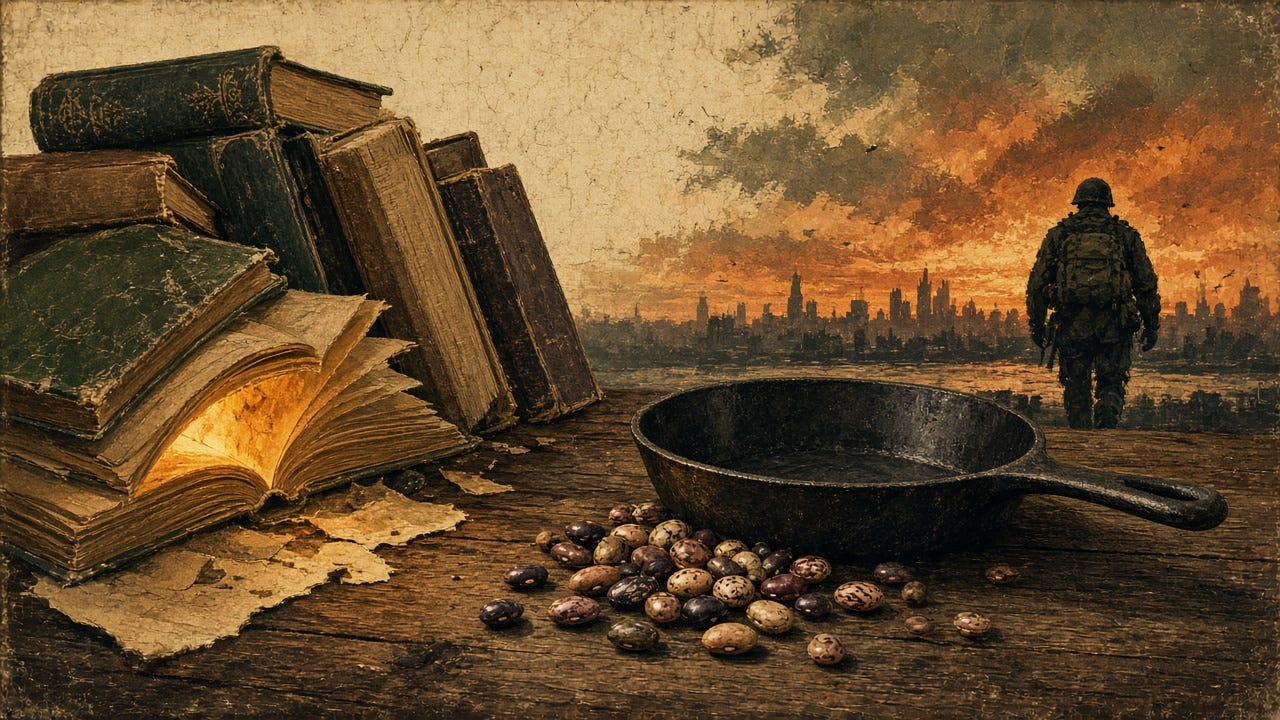
When people ask what inspired my writing, whether it’s the post-collapse survival of the Bougie Apocalypse series (The Cough Is Loose, Staying Human, and Zombie War), the historical time-travel grit of The Last Romans (dropping modern special operations forces into Constantinople in May 1453), or the political thriller tension of The Principate (exploring an American Republic reflecting the transition from the Late Roman Republic to the Imperium), the short answer is a mix of a lifelong obsession with good storytelling, hard-earned real-world experience, and a stubborn refusal to just sit back and complain about the state of modern fiction.
If you want to trace the real DNA of these stories, it breaks down into a few distinct pillars:
1. The “Curious Education” of a Military Brat
A massive part of where my worldview and storytelling instincts come from started long before I ever put on a uniform. As I wrote over on Security n Cigars in my article “A Curious Education: A Military Father,” growing up navigating the unique environment shaped by a father who served in Vietnam instilled a very specific lens on resilience, preparedness, and human nature under pressure. That background didn’t just teach me how systems work, or how they fail. It taught me how ordinary people react when the comfortable veneer of modern civilization gets stripped away overnight.
2. An Eclectic Deployment Library
Books were my lifeline through 21 years in the U.S. Army, especially during deployments and field exercises. My reading list was always a chaotic, high-mileage mix of speculative fiction, fantasy, and horror that I’d cram into rucksacks and vehicle hatch boxes.
The heavy hitters that shaped my literary DNA include:
Sci-Fi & Pulp: E. E. “Doc” Smith, Robert Heinlein, Isaac Asimov, Gordon R. Dickson, and Jerry Pournelle. Smith’s pure space-opera pulp taught me scale and momentum; the others taught me world-building, technical realism, and how to look at macro-level societal shifts through a narrative lens.
Myth & Epic: J.R.R. Tolkien and C.S. Lewis, who anchored my appreciation for deep lore, moral clarity, and high-stakes consequence.
Horror & Adventure: Stephen King (primarily The Gunslinger and The Stand), and Anne Rice. King showed me how to write terrifyingly plausible breakdowns of society, while Rice mastered the richness of atmospheric, character-driven narrative.
3. Two Decades in Uniform
That reading list sat on top of the work itself. You can’t spend 21 years serving in the Army without it leaking onto the page. From the rhythm of operations and the gallows humor of soldiers to the gritty reality of logistics, command decisions, and small-unit dynamics, my military service provided the bedrock of realism for everything I write. Whether it’s modern operators holding the walls in The Last Romans, political and security maneuvers in The Principate, or society collapsing in Bougie Apocalypse, I wanted to write characters who don’t just panic, but actually know how to problem-solve under extreme duress.
4. A Lifelong Love for Pure Science Fiction and Speculative History
All of that fed a lifelong love for pure science fiction, military speculative fiction, and alternate history in all their forms. The genre has always been the ultimate sandbox to explore “what if?” scenarios, whether that’s projecting a near-future pandemic collapse, dropping modern capabilities into a medieval imperial siege, or modeling the political trajectory of an American Republic on the Roman transition to empire. Good storytelling lets us hold a mirror up to our own culture while keeping you turning pages late into the night.
5. Stopping the Complaining and Starting the Writing
The final catalyst was simple: there is a genuine lack of good, old-fashioned pulp fiction and plain old good science fiction in the modern market.
For a long time, I found myself shaking my head at what was missing from the shelves, stories that value pacing, grit, competence, and sheer entertainment without losing their brains. Eventually, I got realigned and realized that complaining about it accomplishes nothing. It was time to stop talking, sit down at the keyboard, and start writing the books I actually wanted to read.
Dive Deeper into the Work:
The Bougie Apocalypse Series: Find the books on Amazon (www.amazon.com).