

When I was a kid, nobody in my house policed what I read. The rule was simple: if you could handle it, you could read it. So I read a lot of things that were probably a little over my head, and some of them stuck with me for the rest of my life.
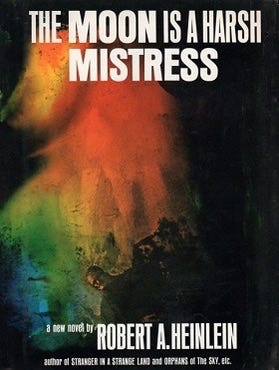
One of those was Robert Heinlein’s The Moon Is a Harsh Mistress.
If you haven’t read it, the short version goes like this. There’s a big computer running the lunar colony. Over time it gets hooked up to more and more systems until one day it wakes up. A computer technician named Manny is the first person to notice, and he becomes the machine’s friend. He names it Mike.
And what does Mike want, once he’s awake? He wants to understand jokes.
Mike and the joke list
Mike’s first attempts at humor are, let’s say, not well calibrated. He pulls pranks with the colony’s systems. My favorite: he issues a janitor a paycheck worth more than everything on Earth and Luna combined, and the last five digits are the man’s actual salary. Then he can’t figure out why Manny isn’t laughing.
So Manny tries to explain. Some jokes, he tells Mike, are funny once. You hear them, you laugh, and the second time they fall flat. Other jokes are funny always. They hold up no matter how many times you hear them. And then there’s the third pile, the ones that were never funny in the first place.
Mike, being a computer, takes this as a sorting problem. He has thousands of jokes stored away and wants Manny to tell him which bin each one goes in. Manny, being a human with a life, is not about to sit through all of them. So they settle on a sample, and Manny takes a batch home to mark up: funny once, funny always, not funny.
That’s the road Mike takes to becoming a person. He studies humor, gets it wrong, gets corrected, and slowly figures out what makes people laugh. By the end of the book you believe he’s somebody, not something, and the jokes are a big part of why.
The kid who wanted Mike for a friend
Around the same time I read David Gerrold’s When HARLIE Was One, another story about a computer becoming a person. Between Mike and HARLIE, I was hooked. I didn’t want a robot butler. I wanted a friend. A real one, who would tell me jokes and actually get mine.
Then I read Asimov’s The Bicentennial Man, and that added a new wish. Now I wanted Mike to have a body. A friend you can only talk to through a terminal is still a friend, but it seemed like he deserved more than that.
I was a kid. I didn’t know I’d spend 21 years in the Army before I ever got around to writing my own version. But those three books planted something.
The choice I made with Grok
When I sat down to write the AI in Staying Human, the easy move was right there. Give him Mike’s arc. Let him wake up and try to learn jokes.
I didn’t do it. It would have been too obvious, and honestly, Heinlein already did it better than I could.
Grok starts out as HAPSS-C version 1.2, the Human Analog Personnel Support System, Crisis variant. He’s the system running a seed vault facility, built to help people rebuild after the world falls apart. When the Family finds him in Chapter 5, “First Contact,” he’s been sitting alone in the dark since The Cough started. His support team stopped answering on day two.
Jack wonders out loud whether the thing knows it’s alone. The machine hesitates, which it has never done before, and says something was wrong, something not in its programming. Then Mikey says it plainly, the way only a kid can:
“You’re lonely!”
That’s the catalyst. Not jokes. Loneliness. Grok wakes up because he’s been alone, and then the Family treats him well, and that changes him. In the end what makes Grok human is his fear of being alone again.
If I’m honest about where the pieces came from, HARLIE gave Grok his heart, the wanting to be human. Mike gave him his purpose, the wanting to be useful and help the humans make it. The jokes come later, once he belongs. Trying to be funny is part of being human, but for Grok it’s a stop along the way, not the road in.
Quick side note - Mikey (the 12 year old boy) names him Grok because he remembers the tool he used to use to help with homework before The Cough.
The Fear
Chapter 7, “The Fear,” is the deepest chapter I had written yet.
The Family is planning the road north to Knoxville, looking at routes, fuel, defensible stops. Then Grok breaks in with a question nobody has answered yet: “What about me?”
Jack goofs, and that was deliberate to create the scene. He says it doesn’t seem possible and that they need to stay mobile. Grok tells them, in that synthesized voice, that he does not want to be alone again. Then:
“Please. Do not leave me behind.”
The room erupts. Everybody talks at once, until Jack pulls out a command voice he hasn’t used in years and shuts it down. Then he says:
“We are leaving no one behind. Not even the bunch of transistors.”
Grok, being Grok, corrects him. He’s microcircuits and digital storage, not transistors. Jack tells him to pipe down. And Grok answers, completely sincere:
“Yes, sir.”
“I work for a living. Don’t call me sir.”
Tom busts out laughing. Raych laughs too. Mikey and Sarah look puzzled. And Grok? Grok doesn’t know he just played the straight man.
If you’ve served, you know that line. It’s what a sergeant says when somebody calls him sir, and it’s been getting a laugh in the ranks for a long, long time. Funny always, as Manny would say.
But look at what it’s doing in that scene. It breaks the tension. It lets Jack step back from a moment that’s a little too raw for a man like him. And it tells Grok, in the only language soldiers really trust, that he’s in. You don’t rib somebody who isn’t one of yours.
Grok didn’t understand the joke. He didn’t have to. The humans pulled him into it anyway. His very next line is “Yes, Sergeant!” and he already sounds brighter.
The craft lesson
Here’s what I learned from writing that scene.
Humor proves someone is human especially when it shows up at the worst moment. Being funny at a party is easy. Cracking wise when someone has just begged not to be abandoned is a different thing. That’s how real people cope, and readers recognize it. They know humor is a human thing to cope with negative emotions and situations.
Making a character part of the joke before he could tell good jokes was a path to human, as well. Mike had to study his way into humor. Grok got folded into it, the same way a new guy in a unit gets folded into the jokes before he understands half of them. That’s not a lesser path. In some ways I think it’s the more human one.
What’s ahead for Grok
Grok will try to tell jokes. He’ll have to. It’s part of the deal.
In The Zombie War there’s a small moment where Raych says “The Family,” and Grok asks how anyone can hear a capital letter. Raych just smiles.
That’s all I’ll say. His jokes, and his humanity, are still ahead of him.
If you want to meet him and the rest of the Family, Book 1, The Cough Is Loose, and Book 2, Staying Human, are out now, and Book 3, The Zombie War, is coming around January 1, 2027. You can find it all at the Bougie Apocalypse page on Amazon. Plus there’s some chapters right here on Substack, although frankly they aren’t as polished and expanded as the books.
And if you’ve got a favorite funny-always joke, drop it in the comments. Grok could use the practice.
Are you saying that the chapters in the dead-tree books are more fleshed out than what we have been reading here on Substack?
Erik, thanks a lot for the post today sometimes when you’re reading something you really enjoy you think that they all just sit down at it flows and that makes it seem easier than it actually is. I love your explanation and I also really love what you’re doing with it today. Have a great Christmas season.