

This article is not my usual Bougie Apocalypse fare, but I felt the need to write it. There is altogether too much loud craziness about AI and far too little discussion of what its value is. It’s not here to replace the creative, it’s here as a tool that enables even more creative time. If that sounds intriguing, read on dear reader.
The AI freak-out is going to end the same way every other great freak-out ended. The technology becomes normal. People use it every day, including the people who freaked out the loudest.
I wrote that note a couple days ago. The history behind it is longer than most people realize. Basically every generation has resisted, even freaked out over, the new technology. From the very beginning of actual writing. And very likely some caveman declared that the wheel was evil and going to destroy manual labor. Here’s a very brief history of some of that to kick things off.
Socrates thought writing itself was a threat to real thought. In Plato’s Phaedrus he argued that written words were static. He said they could not answer questions, would weaken memory, and would create the appearance of wisdom without the substance. We only know what he thought, said, and taught because Plato ignored him and wrote it down on papyrus. The tool Socrates rejected is the only reason his rejection survived.
Gore Vidal in 1984 claimed the word processor was erasing the idea of literature. In reality, computers with word-processing software made writing faster. They stored everything digitally so your work no longer swamped the house in paper. They made editing far quicker than the old cycle of pen, paper, and retyping.
Established journalists spent the early 2000s sneering at bloggers as kids in their parents’ basements with no editors and no fact-checkers. Glenn Reynolds and the rest of the early blogging crowd did not invent political commentary. The internet let them research faster. A simple hosted blog let them publish a readable site the same day, without a webmaster or a gatekeeper. Within a few years the people who had sneered were either blogging themselves or watching their audiences leave.
The pattern is consistent. The loud claim is that the new tool will ruin or replace the human part. The practical result is that the people who used the technology that reduced friction could do more of the work that actually required creativity, judgment and sustained attention.
I started using AI because I had a concrete problem. I had written a manuscript and then edited it. That process had eaten so many hours that other important things had stopped happening. I began using Grok for the mechanical parts of editing and for formatting help. It was useful. Then the problems multiplied and the solution scaled.
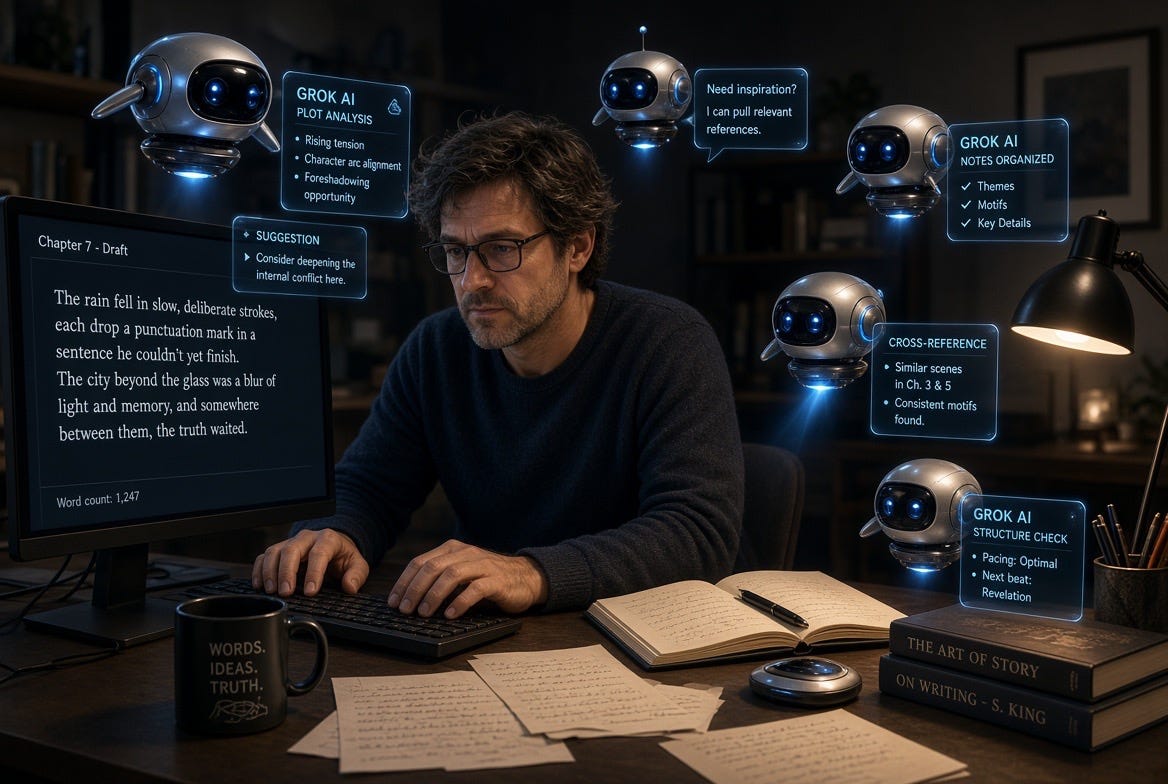
I now have a small army of Grok Bots that report to a chief-of-staff bot. I call that bot Chief. The bot calls me Supreme Overlord. It’s fun. The bots don’t write the essays or the fiction. They handle the layers that used to sit between the idea and the finished work. They also handle the recurring tasks that used to compete with writing for the same hours.
The Kitchen bot builds the weekly dinner menus from my own Paprika library of 750+ recipes. It knows the household rules. I cook five nights a week. Tuesday and Friday are usually out. Sunday is almost always some form of roast chicken. It rotates proteins and cuisines. It favors quicker recipes on busy calendar days. It produces the shopping list. I no longer spend the time wading through cookbooks and Paprika, instead I spend time cooking.
The News bot delivers a morning brief across the specific beats I actually care about. Those beats are local and state news, space, U.S. politics, France, Iran, and the odd or unusual layer. France and Iran shift as events change. The odd layer is Florida Man territory. I used to spend about an hour every morning searching and curating. Now I read what has already been filtered.
The Substack bot handles outlining, research support, editing passes, and scheduling for both Security n Cigars and Bougie Apocalypse. I still gather the ideas and write the pieces. It takes the mechanical steps that used to sit between the draft and the published post.
There are others for publishing logistics and marketing on the book side. Everything runs through the chief-of-staff bot so I am not managing eight separate conversations. Nothing public goes out without my explicit approval. No calendar or email changes happen without my explicit approval. I will never give the bots access to anything financial. The fiction and publishing identity stays strictly separated from the Security n Cigars identity.
The net effect is roughly ten hours a week of administrivia that no longer has to be done by me. Those hours go back to cooking, to writing, and to time with my wife. The larger result is that a one-man operation can sustain two Substacks. That means two pieces a week on Security n Cigars and two chapters a week on Bougie Apocalypse. It also means a novella of about 30,000 words roughly every three months. That cadence was not realistic when the non-writing work competed for the same hours as the writing.
AI is here. The freak-out will look silly in a decade. The word-processor and blogger panics look silly now. The useful question is narrower. Which of the boring, high-friction, low-judgment tasks in your own week can be handed off so the parts you actually care about get more of your time? Find those. The tools are already good enough for the rest.
Do you want to edit and assemble manuscripts or do you want to create stories and write them? I know my preference.
Stay Human!
Ten hours a week going back to cooking and writing is exactly what I want AI to be for. Nothing public going out without your explicit approval is how I think it should work too. You review, approve and publish, then move on with your life. A bot that calls you Supreme Overlord is a strong management choice lol
Thanks for the down to earth take! I hadn't thought about having a bot curate news I'm actually interested in. I used to follow science news but it got buried long ago. I might be able to set that up for myself again. I know it's sure faster to have the bot find recipes for me, rather than having to wade through the torture that is food blogs.