

The map didn’t care about the dead, and neither did the miles. Over the next thirty-seven hours, the geography between Franklin and the higher ridges leading toward the Tennessee border blurred into a grim routine of clutch, brake, and scan.
We operated on a grim, terrifying architectural math. Out here, the landscape presented a silent paradox: every house,store, and office building we passed was a quiet sepulchre holding the uncounted who died in their tracks when The Cough hit on Day 1. We didn’t know the exact toll—no one was left to tally the bodies—but the sheer scale of the silence was horrific. But the ones who turned on Day 2 didn’t stay inside—they spilled out onto the asphalt, crowding the highway shoulders and wandering the open roads in a ceaseless, mindless hunt.
Inside the 4Runner, the air smelled like gun oil, dry cabin heat, and the faint, lingering notes of a decent single-origin roast I’d managed to vacuum-seal back at the last stash. Even when the world has gone to hell and humanity is reduced to a rounding error, some standards are non-negotiable.
We operated on a seamless, low-bandwidth rhythm. Over the short-range comms, Tom’s gravelly voice would crackle through from the F-150.
“Jack, I’m seeing fresh drag marks across the shoulder two klicks ahead. Looks like something heavy hauled itself out of the brush.”
“Copy that, Tom,” I reply, tracking the switchbacks ahead of our hood. “Raych, keep an eye on the right tree line.”
Beside me, Raych didn’t even shift her posture, just adjusted her grip on her rifle. She’s been my north star through every nightmare this century has thrown at us; when things get tight, her absolute calm is the anchor that keeps the whole operation from drifting. “Clear on the right,” she murmurs, her voice steady as a heartbeat. “Just pine trees and frozen ditches.”
Up front—or rather, piped straight through the dash—Grok decided it was time to chime in.
“Telemetry update complete,” Grok’s synthesized voice drawled, carrying that peculiar mix of computational precision and mild existential exhaustion we’ve all grown accustomed to. “Acoustic and thermal tracking indicates a 14% increase in localized clustering density along the primary transit corridors. Also, Jack, your current caffeine-to-stress ratio is projecting at roughly three hours past optimal focus. I recommend a bean adjustment before we hit the state line.”
“Thanks for the medical and nutritional advice, Grating Intelligence, Inc. Keep your eyes on the thermal sensors and less on my blood pressure,” I muttered.
“Merely optimizing human asset longevity,” Grok replied instantly, a digital edge of defensive sass clicking into the audio output. “Given that the surviving demographic stands at zero-point-five percent, asset preservation is mathematically critical. Speaking of which: tactical evasion is no longer viable. Leaving isolated units unaddressed results in exponential scent-trail compounding. Elimination protocols must be absolute.”
Grok wasn’t wrong. Across two months and seven hundred miles of scouring a dead continent, our little convoy of seven souls—Jack, Raych, Tom, Sarah, Mikey, Earl, and Kaylah—was the literal sum total of human life we had managed to find. Seven people who were not only biologically immune to the pathogen, but tough and competent enough to survive a planet full of teeth. You couldn’t out-drive the arithmetic, and you couldn’t afford to leave a single straggler behind to feed the hive.
During our mid-afternoon consolidation stop at an abandoned gravel extraction yard off US-64, the rest of the crew went to work with the quiet, practiced efficiency of people who knew their lives depended on every bolt being torqued and every tank topped off.
Earl climbed down from the massive cab of the Peterbilt, his joints popping in the cold mountain air, wiping grease off his calloused hands with a shop rag. “Rig’s running hot on the transmission temp gauge, but she’s holding oil,” Earl rumbled,nodding toward the heavy box trailer behind him. “We keep this pace up through the mountain passes, and we’re going to need to check the differential grease before dark.”
“Copy that, Earl,” Sarah said, stepping out from the passenger seat of the F-150 with a clipboard in hand. She was running our logistics and inventory tracking, and her pencil was already moving down her manifest. “We’ve got three spare gallons of heavy-weight gear oil in the secondary bin. Kaylah’s already checked the auxiliary jerry cans for the generator and water filtration setup.”
A few yards away, Kaylah was busy securing the cargo lashings on the flatbed trailer behind her truck, her movements crisp and exact. She caught me looking and gave a sharp, reassuring nod—no wasted motion, no complaints about the freezing wind cutting down off the peaks.
Mikey, handling rear-guard observation from the bed of the trailing pickup, lowered his binoculars and swung down over the tailgate. He’d earned his place back there, forged in the fire of Clover Lane alongside his mother Sarah and his grandfather Tom. “Nothing tailing us on the long straightaways,” Mikey called out, his breath pluming in the frosty air.”Saw a couple of strays wandering through a burnt-out gas station about five miles back, but they didn’t have the legs to keep our dust.”
“Good eye, Mikey,” I said, leaning against the fender of the 4Runner. “Keep that optic clean. The dead aren’t just wandering anymore; they’re networking. If we see ‘em, we drop ‘em. No loose threads.”
“Got it, Dad,” Mikey replied, racking the bolt of his rifle to check a chamber clear before resetting.
The word still caught in my chest sometimes—not because it felt wrong, but because of how much it cost to earn it,knowing what happened to his real father back when the world broke. I just gave him a single, sharp nod, watching him shoulder the rifle and lock back into his arc of fire.
The road tested that zero-tolerance policy less than an hour after we rolled out of the gravel yard.
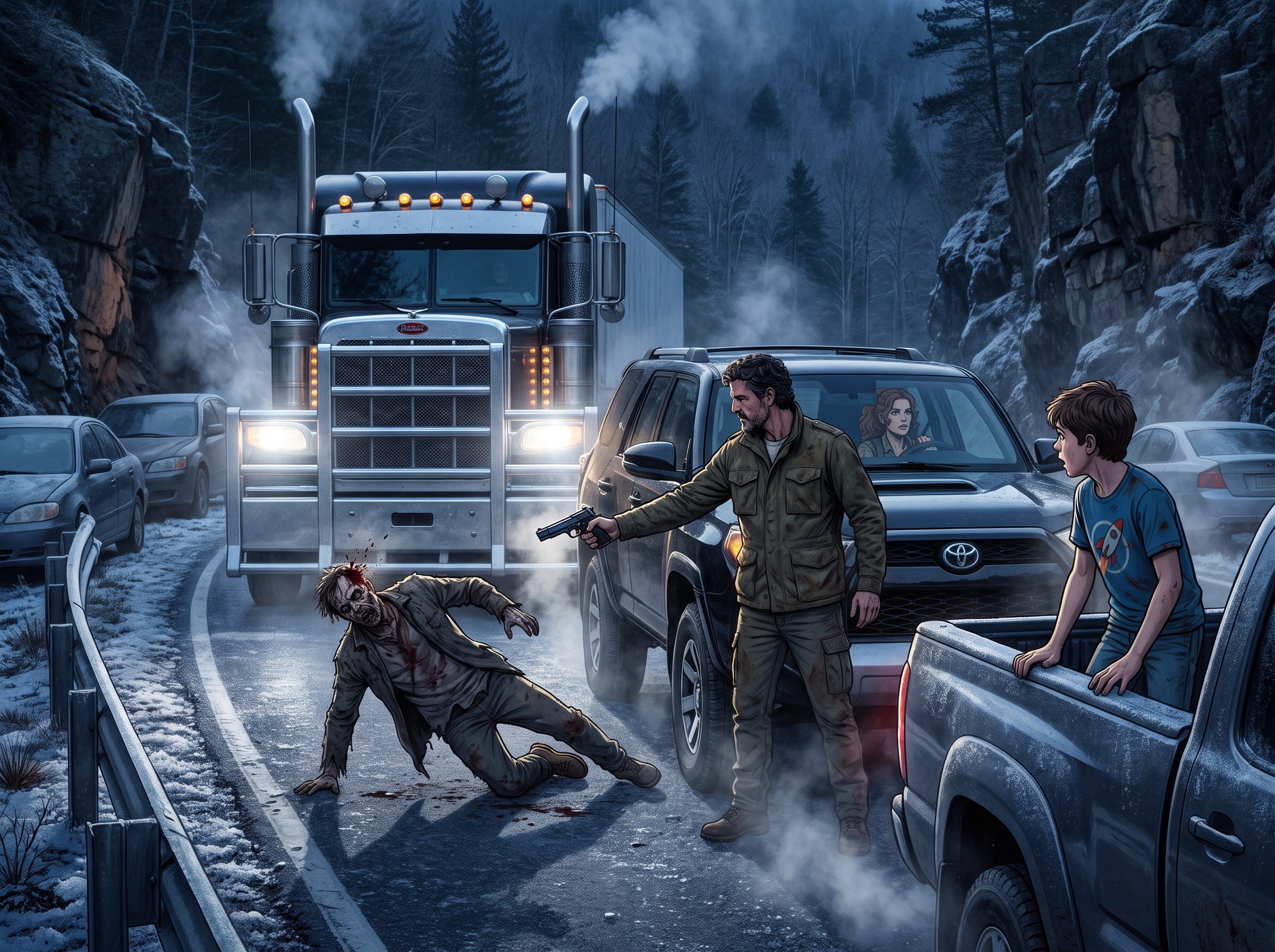
We rounded a tight, rock-walled curve where a string of abandoned civilian cars choked the shoulder. A lone Walker—jacket shredded, skull half-caved—lunged blindly from behind a rusted-out delivery van directly toward the Peterbilt’s path.
Earl didn’t even bother hitting the brakes; at this speed, slamming them on a downgrade with twenty tons behind you was a recipe for a jackknife. He just blared the air horn—a bone-shaking, earth-shattering roar that echoed off the granite cliffs.
The blast stunned the creature for a split second, veering it slightly wide. That was all the opening we needed.
I whipped the 4Runner around the tail of the big rig, stepping out the second the tires crunched to a halt. I didn’t waste time drawing; the Wilson Combat was already clearing leather. One round of .45 ACP caught the Walker dead in the temple, dropping it instantly into the slush before it could bounce off the rig’s heavy brush guard.
“Keep rolling, Earl!” I called into the comms, jumping back into the passenger seat as Raych slammed her door shut.
“Rolling,” Earl’s voice rumbled back, steady as iron.
“Clean execution,” Grok noted as we accelerated back onto the blacktop, his interface flashing a green diagnostic confirmation. “Though your recoil management could use another half-grain of powder. Just a thought from your friendly local intelligence.”
I glanced at Raych. She just smiled faintly, shaking her head. We didn’t stop to clear the body, but the message was logged by every single one of us. Every mile closer to Knoxville meant tighter packs, smarter movement from the dead, and zero margin for error as we fought to keep the last fraction of humanity breathing.