

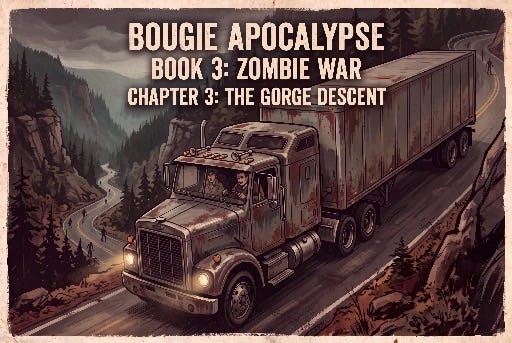
The high, sunlit ridge behind us was a memory by the time we hit the first real set of switchbacks on Highway 23. Dropping down into the gorge was like stepping into a cellar. The granite walls closed in on both sides, blocking out the morning sun and plunging the asphalt into a cold, slate-gray shadow that made your breath plume white in the cab.
Up ahead, the Peterbilt took the tight curves with a deep, groaning wheeze of air brakes and the heavy song of its Detroit diesel.
Inside that massive cab, twelve-year-old Mikey was sitting bolt upright in the high passenger seat, his eyes wide as he watched Earl handle the twin-stick shifter like an organ player in a cathedral.
“You see that gauge right there, son?” Earl asked, pointing a calloused finger toward the dash while his other hand kept the twenty-ton rig tracking true down the center of the lane. “That’s your manifold pressure. You let that drop when you’re heavy on a downgrade, and you’re gonna have a bad afternoon. A rig this size tells you what she needs. You just gotta listen.”
“Does she pull harder in second when the grade gets steep?” Mikey asked, leaning forward with his elbows on his knees.
“Every time,” Earl grinned, his beard splitting into a wide, weathered smile. “She’s got a stubborn streak, just like my first wife, but treat her right and she’ll pull a house off its foundation.”
Behind the big rig, I kept the 4Runner locked to their spray, maintaining a cautious gap. Raych had the map spread across her knees, her eyes scanning the rock faces and the densely timbered draws rising steeply from the shoulders.
“Look at the gridlock,” Raych murmured, pointing out the windshield.
The shoulder ahead was choked with the monuments of the first week. Abandoned sedans, sun-bleached SUVs, and delivery vans sat half-swallowed by blackberry brambles and pine needles. Most were empty, their doors swinging wide or smashed in, but a few still held the silent shapes of people who never made it out of the basin when the power grid flatlined. Out here, the road was a funnel, and everyone had tried to pour through it at once.
Then Grok’s speaker chimed in from the back, cutting through the low rumble of our engine.
“Jack. Thermal overlay indicates a cluster of stationary and slow-moving signatures approximately four hundred yards ahead, pooling near a jackknifed flatbed blocking the southbound lane. Vector data suggests movement is converging toward the roadway.”
I keyed the radio mic on the dash. “Earl. Heads up. Grok’s flagging a blockage and some company waiting for us just past the bend.”
“Copy that, Sergeant,” Earl’s voice crackled back over the comms, instantly dropping the jovial truck-cab tone for cold, flat professionalism. “I see the tail-end of that flatbed now. Braking down slow so we don’t slide on the frost.”
The Peterbilt’s brake lights flared red, hissing as he bled off speed and brought the heavy rig to a controlled, rumbling halt fifty yards short of the blocked lane. I pulled the 4Runner off to the shoulder, cutting the engine and letting the relative silence rush in, broken only by the ticking of cooling metal.
“All right,” I said, unsnapping the retention hood on my Safariland OWB holster and checking the fit of the Wilson Combat 1911 against my hip. “Let’s clear the road. Raych, you’re with me on the left flank. Tom, bring Sarah and secure the right side by the treeline.”
“Got it,” Tom muttered, already stepping down from the F-150 with his shotgun resting comfortably in his crook, his bald head catching the pale light filtering through the canopy. Sarah stepped out right beside him, her rifle up and scanning the shadows with cold, methodical efficiency.
We moved out in a fluid, practiced line, boots crunching on frozen gravel and dead leaves. But as we closed the distance to the jackknifed flatbed, the hairs on the back of my neck stood up.
The Walkers shuffling out from the tree line weren’t stumbling around blindly the way they usually did. They were drifting forward together, shoulder to shoulder, pulled by the low-frequency thrum of Earl’s diesel engine like iron filings to a magnet. Grok wasn’t just tracking thermal data; he was watching a hive mind wake up in real time.
“They’re listening,” Raych whispered, raising her rifle as the nearest rotting face turned our way, jaws snapping empty air.
“Yeah,” I said, thumbing the safety off the Wilson Combat. “And they brought friends.”