

The coffee was hot, dark, and brewed from the sealed Ethiopian tins Mikey had pulled out of the Kingston Pike country club. We had a twenty-four-hour window where the adrenaline of the initial contact had settled into the quiet, rhythmic hum of two small groups figuring out how to share the same patch of earth.
Isaiah Whitfield sat on an overturned Jerry can, hands wrapped around a battered metal mug, while his people stayed close to the edge of the shelter tarp. They were ten souls total, Isaiah and nine others, six women and three men. Looking at them, you wouldn’t have picked them out as mountain survivalists. They were suburban types from the subdivisions out toward Farragut and Bearden, former accountants, teachers, office managers, and medical techs who had watched their quiet cul-de-sacs turn into abattoirs on Day One. They weren’t raised in these hollers, but Isaiah had shepherded them and taught them to refuse to die when the rest of the world went dark.
Grok’s projection rig cast a pale, low-luminescence green glow across the tailgate of Tom’s F150. We were using it as an impromptu map table.
I looked around at my team. Tom was steady and competent, Raych was more than up to the task of Camp Commander, and Isaiah was already fitting in nicely. Sarah had leveled up big time and was managing food, ammo, and supplies far better than I ever had. I smiled when I noticed Mikey had slipped in quietly to listen.
I brought them to order quickly. “Okay, folks, we’ve had a change to integrate, and it’s going well. Grok was able to debrief our new team members and got a lot of good intel. So, let’s hear what he’s learned.”
“Let’s talk about the density,” Grok said, his synthetic voice level and devoid of theatricality. “And let’s talk about how the opposition has evolved past simple wandering herds.”
Tom leaned against the fender, arms crossed, his eyes fixed on the topographic overlay of Knox County. Raych sat on a camp box beside me, cleaning the bolt of her rifle with methodical, unhurried care. Mikey stood just behind Isaiah, trying very hard to look like an experienced scout rather than a twelve-year-old who had earned his first shotgun not long ago.
“We’ve processed the drone sweeps from the initial pass over Knoxville and cross-referenced what little comms we are getting via Starlink. The human data from Isaiah’s people has been brought in as well,” Grok continued, shifting the display. “What happened in the city wasn’t a slow spread. It was a twenty-four-hour spasm of the virus and the Zombies. Close to two hundred thousand people in Knoxville itself were locked inside their homes, apartments, and office blocks when the Cough hit its acute phase. They died where they stood or dropped in the hallways. Almost overnight. The same thing happened throughout the entire metropolitan area. Nearly nine hundred and fifty thousand humans died of The Cough. Another nine thousand, give or take, are Zombies. Perhaps four hundred fifty to five hundred are what I have begun calling The Immune.”
Sarah, leaning against the cab door, crossed her arms. “The city died in a day. So many dead in there, the disease and rats will mean no one can live there. Except the Walkers.”
“Correct,” Grok said. “The few who escaped did so in the first six hours by clearing the grid before the arterial chokepoints jammed with people, most of them already dying. Based on our tracking of pre-collapse telemetry and outbound toll tags, we estimate fewer than fifty Immunes made it out north toward Clinton. Among them, my probability models suggest Professor Glenn Reynolds got clear before the bridges locked down. His alternate Instapundit site is likely genuine. The rest stayed.”
I took a slow sip of my coffee. “And the ones left inside?”
“They aren’t mindless anymore,” Grok said. “We’ve seen the changes, but Knoxville confirmed the doctrine. The infected aren’t just reacting to noise. They are deploying scouts. We’ve logged multiple instances of isolated Walkers moving with deliberate, linear purpose along primary drainage routes. They are probing perimeter defenses, absorbing small-arms fire to map human survivors, and effectively sacrificing themselves to anchor a hive-mind cluster. On Day 1, they swarmed every square meter of the urban core, hunting anything with a pulse. Domestic animals, stray dogs, deer. Nothing biological was left moving anywhere that had any Zombie density.”
Raych clicked her bolt back into place with a crisp snap. “They cleared the food chain before they started starving for us.”
“Precisely,” Grok said. “Which brings us to the demographic reality. Out of nearly a million souls in the metro statistical area, our thermal drone sweeps put the surviving human population between three hundred and three hundred and fifty individuals scattered across the surrounding counties and ridge lines. The city center is a total write-off. It is unlivable, highly dense, and saturated with roughly nine thousand active hostiles. They’ve all clustered into Knoxville; the suburbs are truly dead. That’s the math. About five percent of one percent were Immune to The Cough, perhaps five hundred people. Since then, roughly four in ten of The Immune have been killed by Zombies, other diseases, injury, and exposure. I assume that accounts for the difference. The rest are the walking dead.”
We all wore the same stunned look. Raych and Tom both gasped. We all knew what had happened, but hearing it in such terms was horrifying. Four months ago, Knoxville had a million people. Now it has three hundred.
“And the other thing, Grok?” I asked, catching the subtle shift in the AI’s data stream.
Grok’s green indicator flickered twice. “Yes, Jack. While running deep-band spectral analysis on the microwave spectrum, I intercepted encrypted, narrow-beam, military-grade packet bursts originating from deep limestone cave systems south of the Tennessee River. The architecture isn’t human-managed. It’s automated, recursive, and aggressive. Another artificial intelligence is operating in this sector. I cannot confirm its parameters yet. Whatever it is, it has almost certainly heard our drone data links and knows we are here.”
The silence that settled around the tailgate was heavier than the mountain humidity.
Tom broke it first. “All the more reason we don’t stay put long. If there’s an electronic footprint out there playing chess with the local grid, we need to make sure our immediate backyard isn’t a staging area.”
Raych nodded. “Yes. Our camp is manageable for space and hygiene, but it’s not very defensible. I’d really like to find something better than this. Especially with so many Zombies.”
“Agreed,” I said, standing and setting my mug down. “Tom, I want a reinforced recon sweep out to the northern sector. Establish a three-mile safety buffer around our position. I want to know every draw, every logging road, and every potential choke point before we bring the rest of the groups in.”
Tom didn’t hesitate. “I’ll take a team out.”
“Naw,” Isaiah cut in, his voice steady. “Lemme take the ground, Tom. I know these hollers better’n any map you lookin’ at, and them suburb boys taught me how to keep my eyes open. I want the young’un with me.”
I looked over at Mikey. The kid’s shoulders straightened automatically, his hand resting near the stock of his .410. Sarah and Raych both started to object, but I held up a hand and met Isaiah’s dark, unreadable eyes.
“You’ve got the lead, Isaiah,” I said. “Keep Mikey close and keep your radios dark unless you have to break silence.”
They were gone most of the day. Raych found a dozen reasons to be near the radio, and Sarah counted the same crate of shotgun shells twice. Neither of them said a word about it, and neither did I.
It was late afternoon when they came back through the laurel, wet to the knees and moving quiet. Isaiah dropped his rifle into the crook of his arm, shed his pack, and looked straight at me.
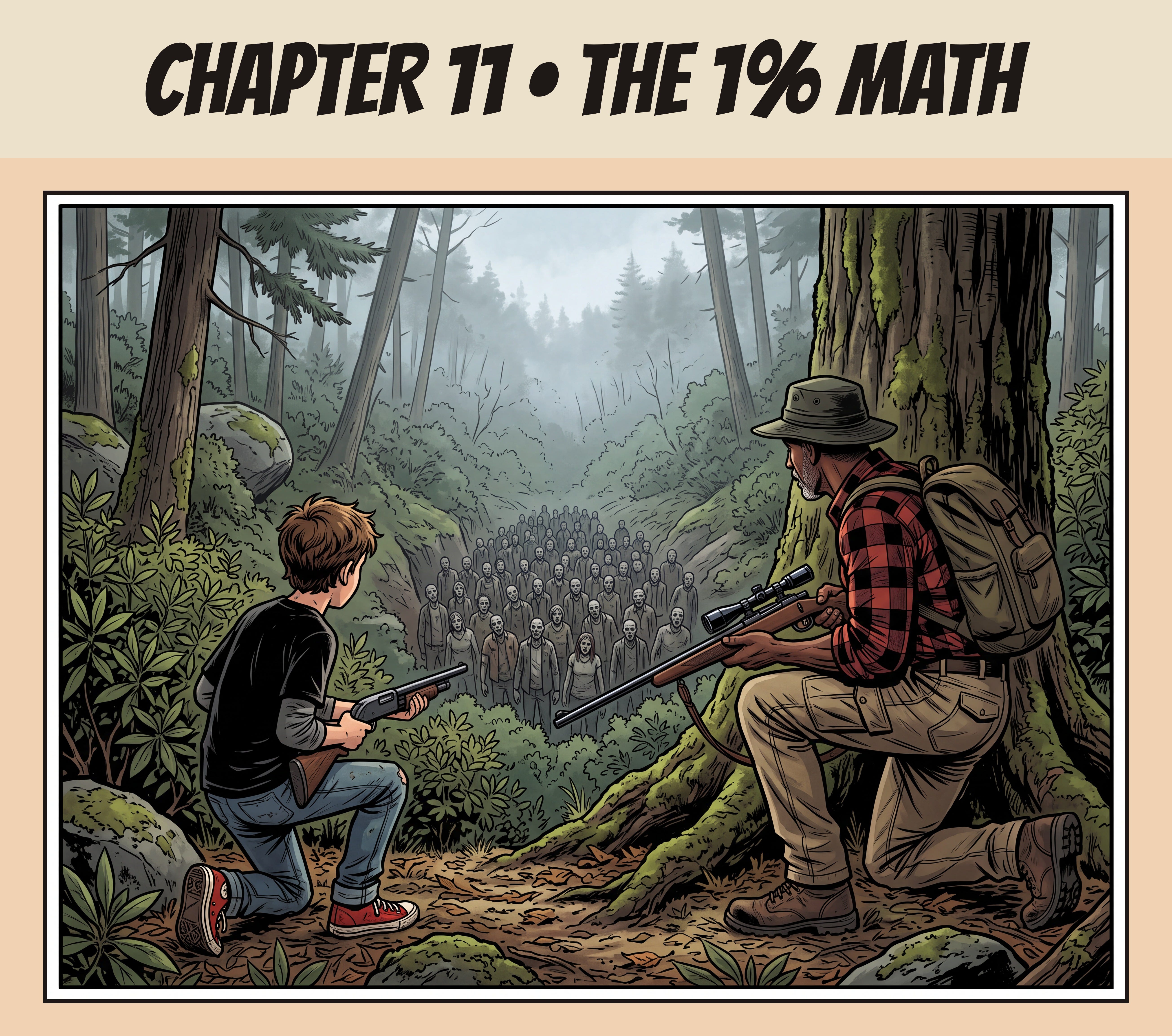
“They massin’ in the north draw, Cap’n,” Isaiah said, his voice low and hard. “Two hunnert of ’em, or so. Tucked right in the brush where them drones’d miss ’em from up high. They didn’t see us, but they a-settin’ right on our doorstep.”
“Sit down, both of you,” I said. “Grok, get this down. Isaiah, walk me through it from the start.”
He lowered himself onto the Jerry can and took the mug Sarah pushed into his hands.
“Took us four hours, near ’bout,” he said. “Second-growth timber, laurel hells thick as hair on a dog, and them limestone draws where the cold just sets and don’t move. November air down in there’ll cut ye. I kept to the ridge spines where I could. The boy here stayed ten paces back and put his boots right in my tracks, just like I learnt him. Never heard a stick break.”
Mikey’s ears went a little red, but he kept his face straight.
“’Bout three mile out, there’s a fold ’tween two low ridges. Deep, and timbered over so ye can’t see the floor from the sky. I smelt it ’fore I seen it. Wet wool, copper, and that sweet-rotten stink. Smelt like a hog lot in August. So I put up my fist and got down behind a big ol’ blowed-down oak, and the boy froze right where he stood. Shotgun up, low and ready. Didn’t have to tell him nothin’.”
He took a long pull of the coffee.
“Looked down through the rhododendron and them gray maples, and the whole bottom of that draw was a-movin’. Like a carpet o’ dark. Packed in tight, shoulder to shoulder. Two hunnert at least, could be more back in under the trees. But here’s what put the chill on me, Cap’n. They warn’t thrashin’. Warn’t moanin’. Just standin’ there with their heads all tipped up, like they was a-waitin’ on somebody to holler ‘go.’”
Grok’s indicator pulsed. “Synchronized stillness. Consistent with what I’ve logged before a coordinated sweep.”
“Call it what ye want,” Isaiah said. “I called it trouble. I checked the wind, figured the distance back to the Peterbilt, and looked at the boy. Didn’t say nothin’, didn’t wave nothin’. Just nodded him south, and we backed outta there slow as molasses. Didn’t stand up straight till we was a half mile gone.”
I looked at Tom, then down at Mikey.
“That right, Mikey?”
“Yes, sir,” Mikey said quietly. “Just like he said. They were all looking up. Every one of them.”
“All right,” I said, resting my hand on my carbine. “The math just caught up with us.”