

The Great Smoky Mountains do not die quietly. They simply wait.
Tom and I pushed through a silent, sunlit vacuum from our camp on the side of I-40. Ancient ridges rolled away to the horizon like petrified waves of a dark green ocean, disturbed by nothing but wind and rot. Then, as we eased past a granite outcropping above a limestone draw outside Knoxville, the air changed. It tasted of woodsmoke, old canvas, and human sweat. It was a faint, unmistakable signature in a world that had smelled only of pine needles and decay since the fortnight.
Grok’s thermal drone pings had put us on this azimuth. But numbers on a digital tablet do not tell you how a position is held. A desperate, untrained mob leaves a trail like a wounded bear, leaving behind broken branches, scattered ration tins, and careless footprints cutting across the contour lines.
This ridge was different.
The approach was a masterclass in dead-space utilization. Every angle of fire was masked by natural laurel thickets. Every approach lane was channeled into a killing ground where a single rifleman could dictate terms. Whoever had laid out this perimeter hadn’t read it in a tactical manual; they knew these draws the way a master watchmaker knows the balance wheel of a chronometer.
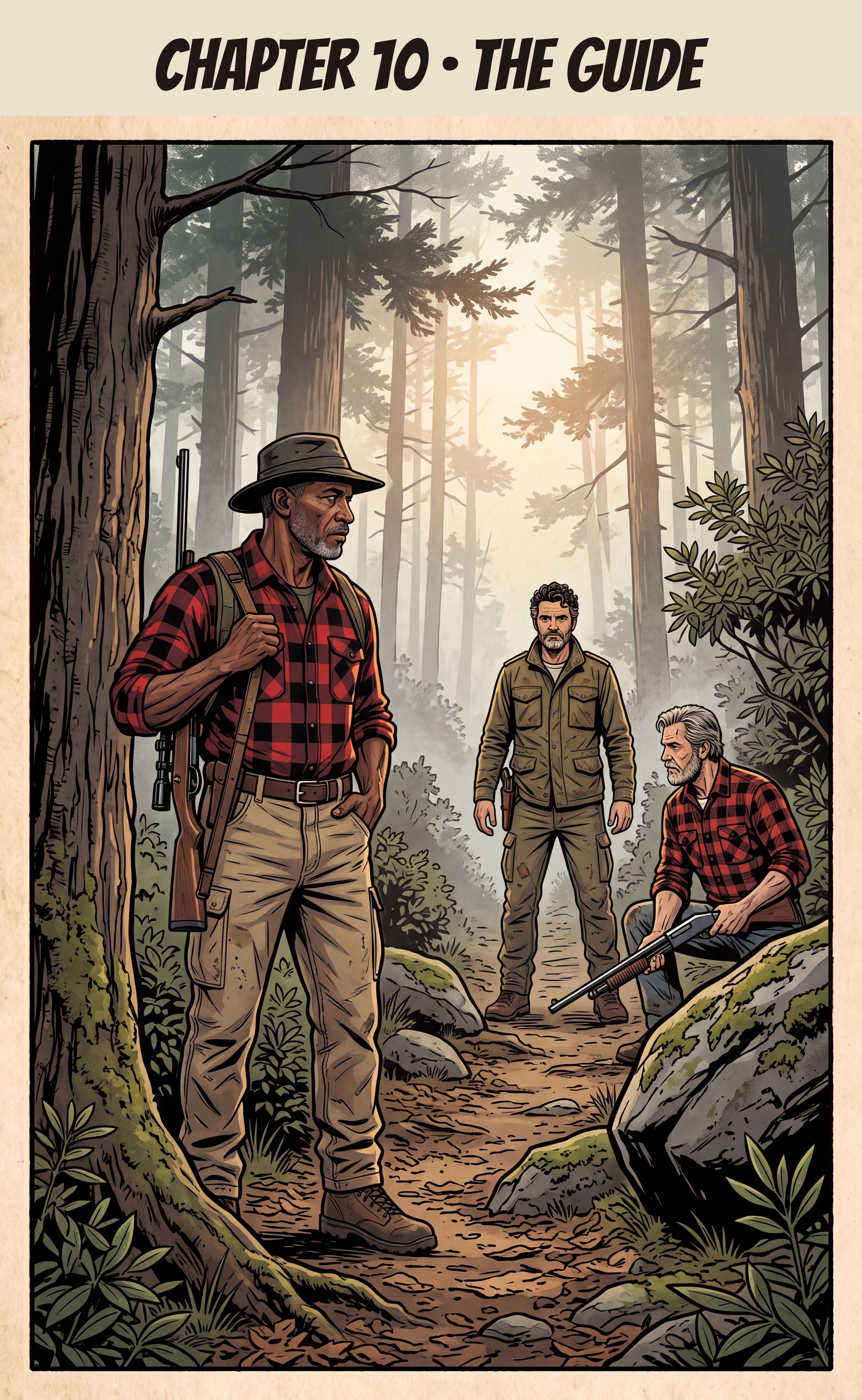
“Clean,” Tom murmured. His hand rested lightly on the checkered walnut forearm of his weapon as he dropped to one knee beside a moss-slick boulder.
It was a Winchester Model 12, a solid-frame steel pump gun from another era, handed down from his father with a coat of well-oiled bluing and a lifetime of hard-earned respect. Jack had spent the past weeks trying to talk him into adopting a modern, modular AR-15 with a free-float rail and a red dot, pointing out the range and capacity advantages of 5.56 NATO over a twelve-gauge tube in an open field. But Tom was wedded to the old steel. It ran clean and true through every drop of mountain rain and red clay, capable of slamming five rounds downrange before a modern shooter could reset his trigger finger. Jack had stopped arguing about it. When the world breaks, a man is entitled to carry the iron he trusts with his blood.
Tom’s gray and brown hair showed his 55 years, and his full beard was the color of weathered iron. His flannel was faded at the elbows, stained with old grease and new pine sap, with the sleeves rolled to the forearms. He moved like a man who had spent a lifetime under hoods and in woodshops, patient and deliberate.
“Too clean for refugees,” Tom added, his eyes scanning the laurel.
“Not refugees,” I whispered back, shifting my grip. “A sentinel.”
And then the sentinel stepped out from behind a massive hemlock trunk as if he had simply condensed out of the mountain fog.
There was no theatrical rustle of brush and no sudden, startled clatter of metal. One second the shadowed trail was empty. The next, he was standing there, blocking the path with an absolute, unshakeable stillness.
He was in his late sixties, carved out of seasoned hickory and sun-baked leather. He had striking dark mahogany skin, deep brown eyes that missed nothing, and a close-cropped head and gray-streaked beard that looked like steel wool. He wore the working uniform of the Smokies: sturdy tan guide pants scuffed at the knees, heavy leather boots caked with red clay, a red-and-black buffalo plaid flannel shirt over an olive drab tee, and a worn canvas boonie cap pulled low against the filtered canopy light. A bolt-action hunting rifle with a high-magnification optic was slung over his shoulder with effortless, predatory familiarity, the wood worn smooth by years of palms resting on the wrist.
He did not move the rifle. I did not lift mine. We stood forty feet apart on a bed of rotted leaf-mold, two old professionals measuring the drop of the hammer without a word spoken.
His dark eyes flicked over my carriage. They noted the way I carried my weight, the squareness of my shoulders, and the worn cordura rig. Then they drifted to Tom and the old Winchester. In a fraction of a second, he computed our geometry and found zero panic.
I looked back at him and saw the same thing. He was a man who had not spent the last ninety days hiding under a bed.
“You’re a long way from the interstate, Sergeant,” the old guide said. His voice was like dry gravel rolling down a tin chute. It was low, resonant, and salted with the easy cadence of the high ridges.
“We follow the pings,” I said, keeping my hands loose at my sides. “Name’s Jack. This is Tom.”
“Isaiah,” he replied, his thumb hooking casually into his belt. “Isaiah Whitfield. Used to be folks’d pay me good money to show ’em where the brookies run up these trickles. Reckon these days I mostly spend my time keepin’ my people from stumblin’ right into a nest of them walkin’ dead.”
“Your people,” I said.
Isaiah tilted his head toward the deep fold of the drainage behind him. “Nine souls. Six women, three men. City folks who tucked tail for the high country when the whole shebang went sideways. Wound up stranded up a dry holler with nothin’ but a box of stale crackers and a prayer. I been fending the wolves off ’em since first frost, but my brass is down to three boxes and my salt’s plumb gone.”
We moved back to his hide. It was a makeshift bivouac tucked into the limestone ribs of the ridge. The place was neat, swept clean of debris, and meticulously camouflaged. But the people huddled around the cold ash of the fire pit told the real story. They looked like ghosts waiting for the wind to blow them away. Their eyes were hollow. Their clothes hung loose on frames thinned by months of caloric deficit. Every sudden snap of a twig in the brush made them flinch like hunted deer.
It was clear that Isaiah could ghost through these mountains forever. On his own, he could trap a rabbit, boil creek water, and live in a hollow tree until the trees fell down. He was an apex predator of the high country.
But he was tethered to a stone he could not lift alone. He was playing shepherd to a flock that did not know how to run from a storm. And he was burning himself down to ash trying to keep them all breathing.
“Ten people in a hole in the ground,” I said, looking around the pathetic perimeter. “You’ve got ten thousand Walkers massing twenty miles down in the Knoxville basin, Isaiah. They move like a hive, twenty to one against everything that’s left breathing. You stay in this draw another month, and you won’t starve. You’ll get overrun by a pack that smells your campfire from three ridges over.”
Isaiah did not flinch. He did not puff up his chest or try to feed me some heroic speech about holding his ground. He looked at his people. He looked at a terrified woman clutching a rusted saucepan like a shield. Then he looked back at me.
“I know the cipher, Sergeant,” he said quietly. “My numbers run out about a week back. What’s your play?”
“We don’t run a town hall,” I told him, laying the cards face up on the rough wooden stump between us. “We don’t vote on survival, and we don’t do committees. We run an operational unit. I’ve got a heavy rig, a logistics ledger managed by Sarah that tracks every single calorie, and an intelligence grid run by Grok that reads this valley like an open map. You want to bring your people into our perimeter, you do it under our chain of command. You integrate, you take assigned duties, and you follow the rules. You cross our lines, you play by our standard, or you stay here and feed the dirt.”
Isaiah studied me for a long, heavy beat. Whatever he saw in me, it wasn’t a tyrant. It was a man carrying the exact same crushing weight of responsibility for people who could not protect themselves.
The ego dropped away. Survival had the floor.
“What’re you after me a-doin’?” Isaiah asked.
“You know every drainage, water source, and game trail in these Smokies better than any man alive, I figure,” I said. “I need a Scout Lead. You’ll take your tactical orders from my XO, Tom, and you’ll tie your local knowledge directly into our recon grid. As for your nine people, Raych, our Camp Commander, is going to run them through intake. Everyone pulls an oar. We’ve got watches to pull, sanitation details to run, and gear to maintain. No passengers.”
Isaiah nodded once, slow and final, and reached out a dark, calloused hand.
“Done,” he said, the iron in his voice settling the matter. “Let’s go fetch my bunch.”
The transition back to our convoy staging area on the perimeter of the foothills was a silent, disciplined march. Isaiah moved with the fluid grace of a mountain cat, his eyes constantly scanning the ridgelines, while his nine dependents stumbled behind us like broken clockwork. They dragged their feet, clutching makeshift bundles and staring into the dark shadows of the hemlocks with wide, terrified eyes.
When we cleared the tree line and dropped into our base camp, the contrast hit them like a physical blow.
There was no weeping or aimless wandering here. Earl was down by the Peterbilt, methodically running a grease gun over the steering linkage with the calm, unhurried focus of a man maintaining a cathedral. Sarah was seated on a folding camp stool near the supply boxes, her ledger open, tallying inventory by the pale light of late afternoon.
And sitting at the center of it all, behind a heavy folding table with a charcoal pencil in hand, was Raych.
She looked up as we approached. Her curly red hair was tied back in a high, practical ponytail. Pale blue eyes were sharp against fair, freckled skin. She wore an olive green fleece vest over a gray long-sleeve shirt, dark green cargo pants, and brown boots scuffed from hard miles. She carried that same Viking-raider steadiness that had kept our homestead running for decades and had packed the De Buyer skillet on the day the world ended. She surveyed the ragged semicircle of newcomers not with cruelty, but with the cold, unblinking diagnostic clarity of an NCO who knew that sloppy discipline was just another word for a casualty report.
As HQ 6, Raych owned the heartbeat of this camp. She was responsible for the coffee, the calories, the camp hygiene, and the internal perimeter. And she was not about to let unvetted, fragile dead weight sink an operational unit that had survived three hundred miles of hell.
“My name is Raych,” she said, her voice cutting through the clearing without a trace of artificial warmth. “Up until three months ago, you were passengers in a world that took care of you. That world is dead and gone. There are humans surviving and Zombies trying to kill us. Out here, you are either part of The Family or you are a drag on the axle. Let’s find out what you’re good for.” The capitalization in The Family hung in the air with the weight of an unyielding law.
She worked down the line with ruthless efficiency. Two older women, worn paper-thin by months of starvation and damp mountain air, were assigned immediately to internal support and told to grab a bowl from the mess pot. One of them, gray-haired and trembling, stood there holding the bowl in both hands, as if she expected someone to snatch it back. Raych set down her pencil, came around the table, and wrapped her own hands around the woman’s, steadying the warm tin between them. The smile that crossed her face was the same one I fell for when she was eighteen. “Eat slow,” she said quietly. “Nobody’s taking it from you. Not here.” Then she walked back to the table, and the iron was back in her voice before she sat down. They would manage the cook tent, monitor water purification, and keep the gear racks meticulously organized. In a world where a dirty rag or a spoiled bean meant dysentery and a shallow grave, keeping the hearth immaculate was frontline medicine.
A middle-aged man named Arthur stepped forward, his hands grease-stained and calloused from decades as a small-engine mechanic. Raych made a sharp note on her ledger. He did not belong on a forward reconnaissance patrol, but Earl was going to love having another set of skilled hands down at the Peterbilt motor pool to keep alternators turning and fuel lines clear—which would also relieve Tom from mechanic duty so the XO could focus on leading the tactical teams.
Out of the nine, only a younger couple showed the steady nerves required to carry a weapon along the inner wire. Raych marked them for secondary camp security watch rotations, but with a strict, non-negotiable caveat. They would not pull a single solo shift. They would be paired directly with core Family veterans until they learned how to scan a sector without spooking at every shadow. And first, she would make sure I fitted them out with spare firearms from the go-boxes.
Raych snapped the ledger shut. Her pale blue eyes pinned each newcomer in place as the sharp sound echoed like a bolt-action rifle snapping home in the crisp mountain air.
“Sarah’s got your rations logged, and Isaiah’s briefed you on the latrine lines,” Raych told them. “You pull your watch, you clean your gear, and you keep your camp spotless. Welcome to HQ 6. Get to work.”
Isaiah watched them scatter to their assigned tasks, seeing the instant transformation from a terrified, aimless flock into working parts of a disciplined machine. He looked back at Tom, then over to me, and gave a slow, approving nod.
We had a scout lead. We had seventeen souls on the ledger.
And down in the Knoxville basin, the other ten thousand were still waiting in the dark.