

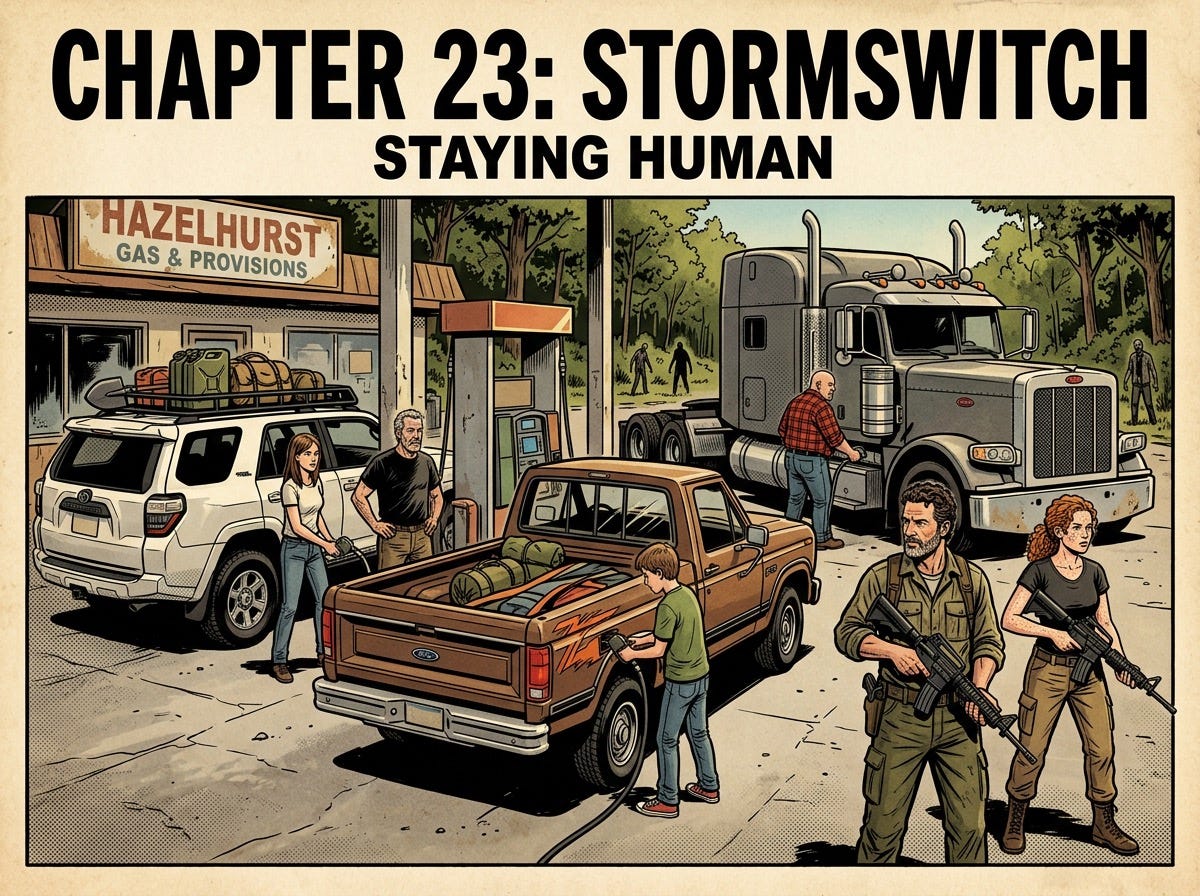
The station sat on a side road north of Hazelhurst, one of those older canopies with a low brick store and a StormSwitch box on the side wall. Grok’s drone made two slow passes before we committed.
“No movement in the immediate lot,” he said. “Two Walkers at the far tree line. Stationary. Product levels in the underground tanks cannot be confirmed from camera, but the site matches Tom’s StormSwitch profile.”
Good enough. We rolled in as a unit and set the shape we had planned under the pines.
Earl put the Peterbilt where the PTO cables could reach the StormSwitch without crossing the whole lot. Engine stayed up. Had to. That was the power plant now. The Cummins settled into a working growl that carried farther than any of us liked. Kayla took truck security at the cab steps, revolver out, eyes on the trailer and the wood line behind it.
Tom went straight to the box with the staged cables. I took the street side with Raych. Rifles up. Hoses would be everywhere in a minute, and a man tripping over a fuel line in a fight was a good way to get somebody killed.
“Sarah,” I said. “Store is yours. Breakers first. Kill the lights. Then POS. Call us when the pumps are alive.”
She nodded once and went in with Mikey on her hip for the first thirty seconds, then sent him back out to the islands. The kid wanted to help. He did not need to be in a dark store if something was waiting behind the chip rack.
The PTO came online with a change in the semi’s note. Tom made the marriage at the StormSwitch the way a mechanic does when the fit has to be right the first time. Cam-lok connectors seated, a firm twist, then a loud click that cut through the engine noise and told everybody the lock had taken. The building took the feed. Somewhere inside, panels woke up.
Sarah’s voice came over the radio, tight and clear. “Breakers. Lights are dead. Canopy stays dark. Going to the register.”
Good. No carnival glow. Just the diesel snarl of Earl holding rpm and the tick of cooling metal on our own hoods.
Walkers heard the truck. Of course they did. The two at the tree line started first. Then more came out of the ditches along the road, drawn by the only loud living machine in miles. They did not sneak. They came on in that new way: faster, grouped, no care at all for the open pavement or the guns waiting on it.
“Street side,” I said. “Hold the edge of the lot. Do not get pulled into the hoses.”
Raych took the right. Tom left the box once the feed was stable and filled the left. We pushed the perimeter out to the street apron and made them cross open ground to reach the islands. Head shots. Slow. Deliberate. Brass bounced off concrete. The smell of fuel started under the gunpowder as soon as the first nozzle came off the hook.
Sarah came out of the store at a run.
“POS is up. Had to force it into offline manual mode, but the pumps are live!”
Then she and Mikey went to work. Gasoline first for the 4Runner and the F-150. Then diesel for Earl. Then the spare cans for the trailer. Hoses snaked across the lot like a bad diagram. Kayla never left the Peterbilt. Earl never shut it down. The engine had to keep singing or the whole station went back to sleep.
A Walker made the corner of the canopy and got within two car lengths of a live hose. Raych dropped it with two clean rounds to the head. It kept crawling until the second shot finished the job. Another tried the ditch line. Tom took that one. I kept the road.
“Cans in the trailer,” Earl called from the window. “Upright. Caps tight. No slosh against the sleeper.”
Mikey moved faster than he looked like he should, hauling cans with Sarah, topping the trucks, calling out gallons like it was a chore he had been born to. The 4Runner drank. The F-150 drank. The Peterbilt took diesel until Earl slapped the door.
“That’s enough. I am fat on fuel.”
Grok kept the drone high through the whole thing. “Additional movement north of the road, closing slow. Recommend breaking station power and rolling in three minutes.”
Sarah ran back inside, killed the POS, and yanked the lighting panel confirmation one last time so we did not leave a lit building behind us. Tom twisted the cam-loks the other way. Another pair of hard clicks and the feed came off. Earl eased the PTO down. The station died. The lot went back to being a quiet, ugly little island of concrete and spilled smell.
We coiled hoses like our lives depended on not leaving a tripwire for the next fight. Cans lashed. Caps checked. Everybody in their seats.
“Load up,” I said. “We got what we came for.”
The convoy rolled off the apron with full tanks and a trailer that finally felt like a reserve instead of a hope. Behind us the Walkers were still coming, drawn by an engine that was already gone. Ahead of us the side roads pointed north. US 441 and US 23 waited up the line, and beyond them the long pull toward Tennessee.
We had fuel. We had a third vehicle. We still had the rule.
Stay human. And do not fight a zombie hive on a gas island if you can help it.