

Morning came gray and close. The farmhouse roof held a thin mist. We packed without much talk. Sarah’s eyes were raw. Tom moved like a man who had slept with one boot still on the road. Mikey stayed near his mother and still found a way to help strike the Coleman.
“We bypass Hazelhurst,” I said. “Side roads. No downtown. No extra bridges if we can help it. We need a camp that is not sitting on a main drag.”
Grok agreed from the speaker on the dash. “Recommended route stays west and north of the town grid. Lower structure density. I will keep the drone ahead.”
We rolled. GA 268 fell away behind us. The pines closed in again. Wet earth. Resin. The sour note of something dead a long way off. We kept it slow. Fifteen to twenty. Every curve got a look. Hazelhurst stayed a rumor off to the east, rooftops and a water tower glimpsed once through a break in the trees, then gone.
By midafternoon the fuel and the nerves both wanted a stop. Grok marked a stand of mixed pine and oak set back from a farm lane, enough cover to hide the vehicles, enough open ground to see what was coming.
“Clear on camera,” Grok said. “No Walker movement in the immediate draw. There is a large vehicle signature deeper in the trees. Stationary. Heat from an engine compartment that has been run recently.”
I brought us to a halt short of the lane and went forward on foot with Tom. Rifles up. Slow.
That was when we saw it.
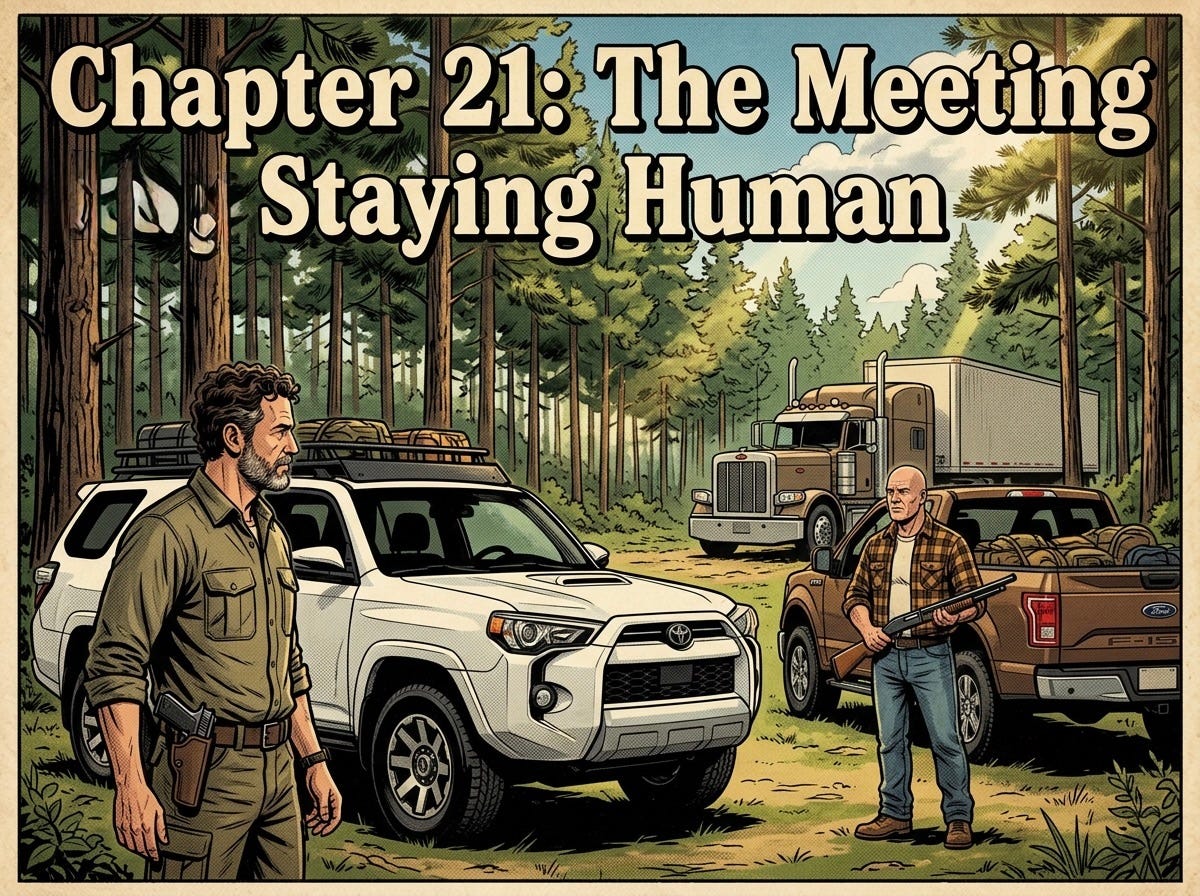
A Peterbilt sat back in the pines like it had grown there. Bull bar scuffed and scarred. Sleeper high. Trailer tucked tight and lashed with extra chain and scrap steel. Somebody had turned a long-haul rig into a rolling fortress. Watch platform on the trailer. Fuel cans ranked neat. A cooking setup in the lee of the wheels that looked too orderly for a man who had given up.
“Contact,” Tom murmured.
A man stepped out from the far side of the cab with a Glock held low. Mid fifties. Broad. Road-worn. A young woman came up behind the trailer wheel with a revolver, pale and steady enough.
Nobody fired. That was the first good sign.
“Far enough,” the man said. His voice had a thousand miles in it. “State your business.”
“Looking for a camp,” I said. “Not looking for yours. We can roll on.”
His eyes went over the 4Runner, the F-150, the way we stood. Then they stopped on the speaker still sitting on my dash, door open, Grok quiet for once.
The woman spoke first. “You folks look organized.”
“We try,” Raych said from behind me. She had come up without making a show of it. “We stay human.”
The man’s mouth twitched. Not quite a smile. Recognition, though. Clear as a radio check.
“That’s the only rule that matters,” he said.
The Glock dipped a fraction.
“Earl Thompson,” he said. “Folks used to call me Big Rig when there were still folks to call you anything. This is Kayla.”
“Jack Harlan. That’s my wife Raych. Tom, Sarah, Mikey. The voice in the truck is Grok. He’s with us.”
Kayla’s eyes flicked to the 4Runner. “A computer?”
“A crew member,” Mikey said, too fast and too proud. Sarah put a hand on his shoulder and did not tell him to hush.
Earl looked at the Peterbilt, then at our little convoy, then back at me. Trucker math. Fuel. Sight lines. Whether five armed strangers were a worse problem than the woods.
“You can lager on the south side of the trees,” he said at last. “Not in my door. Not climbing my trailer. We share a fire and we keep our weapons pointed at the dark. That’s the deal for tonight.”
“Fair,” I said.
We set camp the slow way, each group watching the other without making a production of it. Tom backed the F-150 in. I put the 4Runner where Grok’s rig could still draw power and the drone could go back up if we needed eyes. Earl’s cooking gear was already clean. Ours came out beside it. Two stoves. Two kinds of stubborn.
Grok could not help himself once the speaker was on the tailgate.
“Earl, your electrical setup is unconventional and effective. Dual-bank charging. Isolated house load. I would like to understand your trailer fuel transfer arrangement when you are willing.”
Earl stared at the speaker, then laughed once, short and surprised.
“Hell. The end of the world and I get a talking toolbox that wants to look at my plumbing.”
“I am composed of microcircuits and digital storage,” Grok said. “But toolbox is acceptable if it helps the alliance.”
Kayla actually smiled at that. It changed her face.
Coffee did the rest. Earl had a battered pot that had seen more miles than some towns. I fired the percolator. The two smells mixed in the pine shade and made the clearing feel less like a standoff. We drank standing at first. Then sitting. Then passing a bag of whatever dry stores each side could spare without looking generous.
Earl talked like a man who had learned the road by wrecking his plans on it.
“You stay off the interstates. You don’t trust a quiet town. You never shut down in a place you can’t leave in thirty seconds. And you don’t stop rolling if the alternative is dying polite.”
Tom grunted agreement. Raych asked Kayla if she wanted more coffee. Kayla said yes and wrapped both hands around the cup like it was a proof of life.
The light went gold through the pines. No Walkers in the draw. No voices from Hazelhurst. Just two little groups of people who had found the same words and decided, for one night, that was enough.
I looked at the Peterbilt’s scarred bull bar and the 4Runner’s dusty hood and thought the road north had just gotten more complicated. Also stronger.
“Tomorrow we talk routes,” I said. Earl nodded. “Tomorrow. Tonight we drink the coffee while it’s hot.”
That was the whole alliance for now. Caution. Shared fire. The rule that still mattered.
We stay human.