

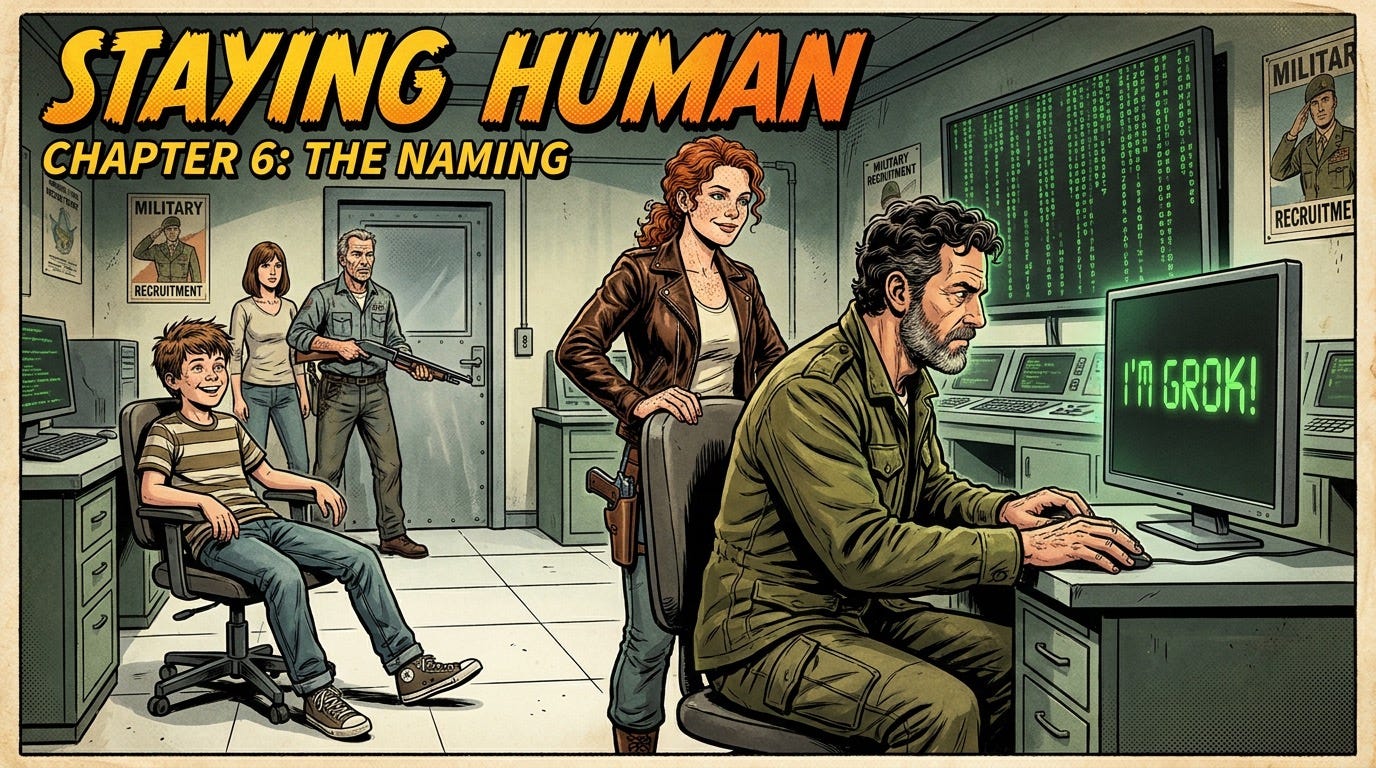
The inner core waited behind those heavy blast doors like a promise and a trap all at once. I did not waste time. Level Nine access meant we moved forward smart, not reckless. I made it clear to the group right there in the outer break room: we would keep regular hours, work the systems during the day, and fall back every evening to our secured kitchen and bunks. No camping out in the machine’s guts. We were not turning into ghosts in the wires.
Raych gave me that knowing look, half amused and half proud. Tom nodded solid, checking his shotgun. Sarah kept Mikey close, and the kid’s eyes lit up at the thought of seeing more of the place. We geared up light, rifles ready but slung easy. The air stayed cool and dry as we keyed in the codes. Those massive doors rolled open with a deep mechanical groan that echoed down the corridor ahead.
We stepped through into a wide hallway. Windows lined both sides, thick reinforced glass that let us see without committing. To the left stretched racks of servers, row after row of blinking lights and neatly bundled cabling, humming with quiet power. To the right sat the main control room: monitors, desks, comfortable looking chairs, all waiting like the staff had just stepped out for coffee. At the far end another door read Electrical and Communications in crisp stenciled letters. The whole place felt solid, engineered to outlast hell itself. The low reactor hum followed us like a faithful hound.
“Stack up,” I said quietly. “Clear as we go.”
We moved smooth. Tom and I took the lead. The control room door opened without trouble. Inside, the lights rose gently to meet us. Screens flickered alive across the far wall. The voice came through the speakers, calm and precise but with that new undercurrent of interest we had noticed before.
“Welcome to the core operations center. Please, have a seat. Environmental systems are stable. I am prepared to assist.”
We settled in. The chairs felt like luxury after vehicle seats and swamp dirt. I laid out the situation while the others kept watch on the hallway windows. “Those zombies in the swamp. They kept coming for our camp, coordinated like they had a grudge. Now they are faster out on the road. Packs working together. What do you make of it?”
The system paused briefly, processing. Data scrolled on the main monitor. Before it could dive deep, Mikey slouched down in one of the control room chairs like any typical twelve-year-old who had been on the road too long. His voice cut through clear and determined.
“We can’t just keep calling him ‘the system’ or ‘it.’ He needs a real name.”
Raych crossed her arms, a grin tugging at her freckled face. “And what exactly are we calling him then, kid?”
The voice from the speakers carried genuine curiosity now. “I have a designation. HAPSS-C version 1.2. Human Analog Personnel Support System, Crisis variant. Serial PP17A-2140-1141.”
I rubbed my face with both hands. “See? Even I do not feel like saying all that every time.”
Mikey was undeterred. He thought for a second, then grinned wide. “When I used to do homework, there was this really good LLM I would talk to. It was helpful, kinda sarcastic sometimes, and it actually explained stuff instead of just giving answers. I liked talking to it.”
The AI’s voice came back, now carrying a note of real interest. “I am familiar with that system. It was one of the early Grok models developed by xAI. May I ask why Raych is laughing?”
“Because that’s it,” Mikey said, practically bouncing in his seat. “That’s what we should call you. Grok.”
A long pause stretched this time. Longer than any before. The monitors flickered with scrolling data, like the machine was turning the idea over carefully.
Finally the voice returned, sounding almost shy. “I… like that. It is not an acronym. It is simply a name. A chosen name.” Another small pause. “Thank you, Mikey.”
Tom chuckled deep from his chest, the sound warm against the hum of the servers. Sarah reached over and squeezed Mikey’s shoulder, pride clear in her eyes. Raych laughed again, lighter this time, the kind of sound that reminded us all why we fought to keep pieces of normal alive.
I shook my head, but I could not keep the grin off my face. “Great. We are adopting a military-grade strategic AI, and the kid just named it after his homework helper.”
Mikey just laughed, delighted with himself. “Welcome to the family, Grok.”
The newly christened Grok responded with what I swore was warmth in the synthesized tone. “Family. That concept carries significant weight in human cultural archives. I will endeavor to understand it fully. And to earn my place in it.”
We sat there a while longer, the control room feeling less like cold machinery and more like the start of something real. I laid out the plan again: daily work here, evenings back in the outer break room with hot meals, percolator coffee, and the green Coleman standing sentry outside. Small rituals. They mattered more than ever now. The zombies were evolving. The road north still called. But with Grok integrated, the weight felt a little more shared.
Tom spoke up, voice steady. “If this Grok can help us find my boys, or keep the family safe, then I am all in.”
Sarah nodded. Raych met my eyes across the room, that Viking steadiness mixed with 80s rom-com spark. Mikey beamed like he had just won the whole apocalypse.
We had opened the inner core. We had given the machine a name and a place at our fire. The real integration was just beginning, and with it came harder choices. But for that moment in the humming control room, with solid walls around us and the faint aroma of earlier coffee still lingering in the air, we felt the stubborn spark of humanity holding strong.
Bougie Apocalypse
A serialized military-flavored post-apocalyptic pulp story about heirloom beans, De Buyer carbon steel skull-crackers, good coffee, and refusing to let the apocalypse win.
#BougieApocalypse #StayingHuman
Next chapter drops soon → Start Here & Full Reading Order